For the past 3-4 years has digitalization and upgrading to the blue sky has been the hottest topic of the IT world. Although it has been superceded with other buzz words such as IoT, RPA, Automation, none-the-less GDPR(?) 🙂 etc… digitalization is still a central part of it all.
Although a lot of start ups today get a heads up for coping up with the speed of the evolution of the digital world, some companies still struggles to catch up with the pace. No one wants to be left behind but a lot of factors can be essential to fly up to the blue sky and be with that cotton looking like entity called the cloud!
I recently had the chance of listening to a big developer event at Microsoft for the past week which is called BUILD and from that, I kind of felt like those companies are feeling… like jeezzz that’s a lot of stuff to take in! Where shall I begin? Where will these stuff fit in and go?
After some nights of pondering (actually days and nights 😀 ), I came up thinking about most developers joke about when discussing something and they got stuck… Use the source, Luke! Use the source!
Most of those companies that are struggling to cope up with the pace of digitalization is either has a number legacy systems or in-house codes that need to adapt in order to take the journey towards digitalization and in close range with the cotton like entity called the cloud. And that’s where I want to begin! That’s my source! (Not in source code from the beginning but we’ll get to that! Don’t get so excited, Luke!) 😉
I need to find the starting point to achieve the blue sky journey… talking (in this blog) about most technical aspects on mostly Microsoft blue space along the way.
The start…
Like any company, we need something to begin with… a (business) scenario and a case. In order to represent this as authentic as possible we’ll set up a financial web application to accept an initial credit from a user of which would then be presented with the user’s transaction history and balance of it’s account. This would represent our legacy and in-house system. And like any other business, let’s start with the requirements… and I hope there is one for you! 😉
The scenario would be as shown below:

Business use case
- A user enters it’s customer id and an initial credit.
- The information is then persisted on the customers account. In our scenario, only one account belongs to one customer.
- The system responds with the transaction history of the credits done by the user and the user’s information like firstname, lastname and of course it’s customer id.
- The system presents the transaction history and user information together with the balance of the account. A transaction history item includes a transaction id, date of the transaction, the account, and the amount (the initial credit endorsed). See below.
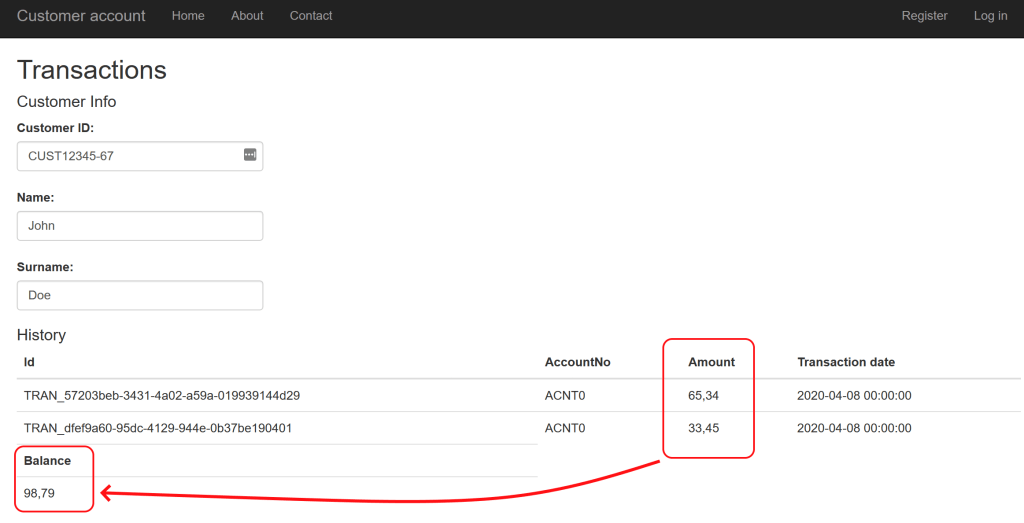
But wait, web-app you may say… isn’t that digitalized already? Yes, but is it built for the blue sky? 🙂 Hold to that thought…
Let’s rewind… to the jurassic age.
If we take a step backward and take a look at our requirement above, and put aside the digital world then the following scenario would apply:
- A user enters it’s customer id and an initial credit. – The user would probaby enter into her bank, fill out a (paper) form with the information above.
- The information is then persisted on the customers account. – The user would then go to a teller and submit the form. The teller would note the credit into the user’s account.
- The system responds with the transaction history of the credits done by the user and the user’s information like firstname, lastname and of course it’s customer id. – Teller would then together with the user information and the note of the recent transaction, take a note of the history from a book keeping log.
- The system presents the transaction history and user information together with the balance of the account. – Teller would then present a receipt of the completed transaction.
Meet the monoliths!
Like any other IT problems there are many ways of solving those problems. Like there are many ways to kill a — (fill in the blanks again… not to upset some pet loving friends we have 🙂 ).
This is not one of those exceptions, here are two solutions I set up to represent above.
One using a en internal memory persistent and the other using a distributed in-memory persistent store. Come along on the next episode to disect these solutions and prepare them to lift up in the blue sky called the cloud!
 Spice n' see